Dr. Keith
The Caine Mutiny Court-MartialDr. Keith is Willie Keith’s father, a physician whose own sense of missed opportunities becomes a final guide to his son. Facing terminal cancer, he tells Willie that he chose financial security over research, regrets the distance that grew between them, and entrusts him with a warning shaped by his own wrong turns. His death is not merely a family loss in Willie’s story: the letter he leaves behind turns paternal affection into an appeal for independent judgment and maturity.
Identity and Private Encounter
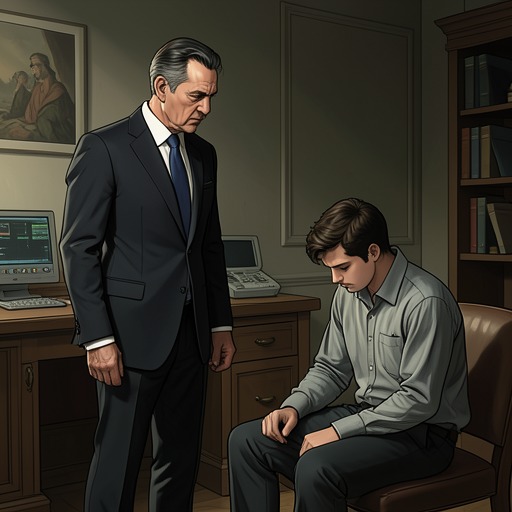
During a family gathering, Willie first notices that Dr. Keith limps and uses a cane. When the conversation in the living room turns into a question session about the Navy, Dr. Keith interrupts it and draws his son into the library for a private conversation. The setting—a mahogany-paneled room lined with books, its windows looking onto a garden with old snow in the flower beds—briefly removes Willie from his public performance as a young officer and puts father and son alone together.
Dr. Keith asks, “How is it, really, Willie—the Navy?” The question is direct where the son’s earlier account of his service has been a performance for the family. Willie answers that he will get by, then asks what is wrong with his father’s leg. Dr. Keith minimizes it as an infected toe. The exchange reveals the asymmetry of what each man knows: Willie has noticed a physical change, but has not been told the danger behind it.
Illness and the Letter
Dr. Keith has known for a long time that the toe trouble is malignant melanoma. He believes the prognosis is hopeless and estimates that he may have only three or four weeks left. Rather than enter the hospital before Willie’s departure, he postpones it until he knows his son has left San Francisco; he also withholds the diagnosis from Mrs. Keith for the time being. His concealment is presented as a deliberate effort not to spoil Willie’s departure, even as it leaves the son to learn the truth in writing.
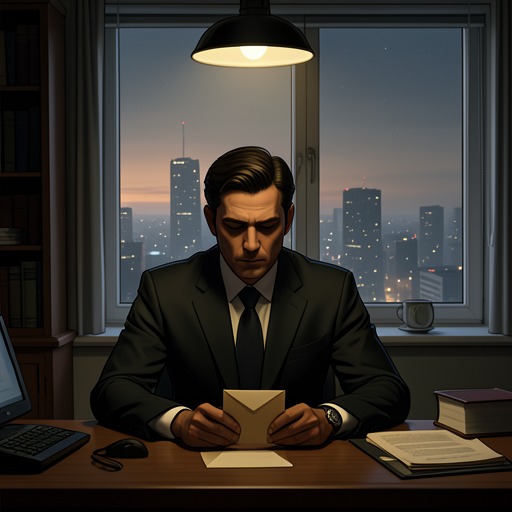
The letter reaches Willie while he is unpacking during temporary duty. Dr. Keith had instructed him to open it on reporting for duty, and Willie decides that this assignment qualifies. As he reads, he rises in alarm, sits on the edge of a chair, and holds the letter with trembling hands while his cigarette burns down and its ash falls unnoticed. The physical details make the disclosure a sudden interruption of his ordinary routine: the father’s private reckoning arrives when the son is far from home and unable to respond in person.
In the letter, Dr. Keith assesses his life as “thoroughly second-rate.” He had wanted to pursue research and believed he had an idea about cancer that would have required three years of systematic investigation. When he fell in love with Mrs. Keith, he thought he could not marry her without first establishing himself in general practice in a prosperous community. He planned to earn money for ten or fifteen years and then return to research, but never did. Looking back, he wonders whether Mrs. Keith would have accepted a modest life if he had insisted on his original ambition. His regret is specific: not simply that he is dying, but that the work he imagined doing never reached even the stage of being written down.
Father and Son
Dr. Keith’s letter is also an admission about the relationship he allowed to lapse. He says that he let it slide through “plain sloth,” particularly because Mrs. Keith seemed eager to take charge of Willie. He wishes he could have met May Wynn and believes that she, the Navy, or both have had a good effect on his son. He calls that change the brightest thought he will take with him into the hospital, making Willie’s growing independence a source of comfort amid his own sense of failure.
His judgment of Willie differs from Mrs. Keith’s. While he says she sees her son as a hopeless baby who will need lifelong coddling, Dr. Keith has come to think that, though spoiled and soft on the surface, Willie is tough at the core. He describes how Willie has managed to do much as he pleased while allowing his mother to feel that she ruled him. This is not presented as a consciously devised strategy; Dr. Keith explicitly regards it as something Willie has done without planning. The distinction lets the father recognize a capacity for agency in a son whom the family’s habitual roles may otherwise keep sheltered.
He points to Willie’s forty-eight demerits as an early test. The episode amused him, but he also saw it as a challenge, and he believes Willie rose to it in an encouraging way. The letter thus connects the son’s earlier disciplinary trouble to the larger question of whether he can meet difficulty without being managed by others. Dr. Keith’s confidence is qualified, not blind: Willie has never faced a serious problem before the Navy, but the experience has begun to show what he may be able to withstand.
Final Counsel and Narrative Significance
Dr. Keith looks back on his life with mixed feeling. He has enjoyed reading and golf and says that he has had as much of both as he wanted; he also insists that Mrs. Keith has been a fine wife and that he has no regrets about marrying her. These satisfactions do not erase his conviction that he failed to use his abilities. His account holds affection and disappointment together rather than making his life wholly barren or wholly fulfilled.
He tells Willie to care for his mother if she lives to great age and to be kind to her, while also hoping that after the war his son will have enough strength to break away from her. He acknowledges her faults but emphasizes that she has truly loved both father and son. His advice recognizes both the obligation of family care and the necessity of becoming separate from a parent’s influence.
At the letter’s emotional center is the instruction to remember Dr. Keith’s wrong turns whenever Willie reaches a crossroads and to choose rightly where his father did not. Willie begins to sob as he reaches the final paragraphs. Dr. Keith’s “Good-by, my son. Be a man.” is at once an intimate farewell and a demand that Willie assume responsibility for his own choices. After reading, Willie wipes his eyes and hurries downstairs to a telephone booth to call the United States. The letter cannot restore the time the two men lost, but it gives Willie a newly explicit measure of his father’s affection, regret, and faith in his capacity to grow.